|
|
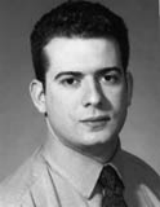
MICHELE MOSCA |
|
Michele Mosca is the Canada Research Chair in Quantum Computation, based at St. Jerome's University within the University of Waterloo with a joint appointment in Combinatorics and Optimization. He is cross-appointed to the departments of Computer Science and Physics. He is a member of the Centre for Applied Cryptographic Research, an Associate Member of the Perimeter Institute for Theoretical Physics. Email: mmosca@cacr.math.uwaterloo.ca
Web Page: http://cacr.math.uwaterloo.ca/~mmosca/
SHORT BIO
B. Math. in Combinatorics & Optimization and Pure Mathematics, University of Waterloo and St. Jerome's University, 1995 (Alumni Gold Medal Winner).
M.Sc. in Mathematics and the Foundations of Computer Science, University of Oxford, 1996 (with Distinction).
D. Phil. in Quantum Computer Algorithms, University of Oxford, 1999.
Robin Gandy Junior Research Fellow, Wolfson College, Oxford, 1998-1999.
Assistant Professor of Mathematics, St. Jerome's University and University of Waterloo (Department of Combinatorics & Optimization), 1999-present.
Canada Research Chair in Quantum Computation, 2002-present.
RESEARCH INTERESTS
Since information processing is a physical task, and quantum mechanics is the best description of nature that we currently have, we need to reformulate the theory of information processing in a quantum mechanical framework.
Furthermore, manipulation of information is often a vital part of various physical phenomena, and we might better understand such physical phenomena by viewing them from an information theoretic perspective. A famous example is Bennett's resolution of the Maxwell Demon "paradox". Another recent example is Schulman's and Vazirani's algorithmic cooling algorithm/experiment.
Prof. Mosca's main research interests are |