|
|
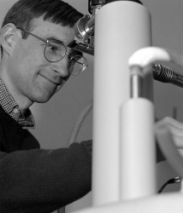
RAYMOND LAFLAMME |
|
Raymond Laflamme is a Professor in the department of Physics. Email: rlaflamme@uwaterloo.ca
SHORT BIO
Ray was born in Quebec city and did his undergraduate studies
in Physics at Universite Laval. He then move to Cambridge, England, where he
survived Part III of Mathematical Tripos before doing a PhD in the
Department of Applied Mathematics and Theoretical Physics (DAMTP) under the
direction of Stephen Hawking. He and Don Page are
responsible for having changed Hawking's mind on the reversal of the
direction of time in a contracting Universe (see his book "A brief history
of time"). After his PhD, Ray became a Killam post-doctoral fellow at UBC
where he met his future wife Jancie Gregson.
Ray moved back to Cambridge in 1990 as a Research Fellow at Peterhouse.
He finally settled down for 9 years at Los Alamos National Laboratory.
He arrived as a Director funded post-doctoral
fellow, became an Oppenheimer Fellowin 1994, just after the birth of his son
Patrick. His daughter Jocelyne was born in 1995 and he became Technical
Staff in 1997. In 2001 he joined the newly founded Perimter Insitute for
Theoretical Physics and the Universtiy of Waterloo where he and Michele Mosca
are starting the Institute for Quantum Computing.
RESEARCH INTERESTS
Information processing devices are pervasive in our society; from the 5
dollar watches to multi-billions satellite network. These devices have
allowed the information revolution which is developing around us.
It has transformed not only the way we communicate or entertain
ourselves but also the way we do science and even the way we think.
All this information is manipulated using the classical approximation
to the laws of physics, but we know that there is a better
approximation: the quantum mechanics laws. Would using
quantum mechanics for information processing be an impediment or
could it be an advantage? This is the fundamental question of the
field of quantum information processing (QIP). QIP is a young field
with an incredible potential impact reaching from the way we understand
fundamental physics to technological applications.
In late 1994,after hearing of Shor 'algorithm, Ray quickly realized that
quantum computer would be hampered by the loss of quantum coherence
(i.e. decoherence). In fact if decoherence is not taken care of, quantum
computers lose their power. After the seminal work of Shor and Steane, Ray and his
colleague Manny Knill laid down mathematical foundation of quantum
error correcting code. With colleagues Miquel,Paz and Zurek, he has also
discovered the most compact quantum error correcting code which correct one
quantum error (more recently, with Knill, Negreverge and Martinez, he
implemented this quantum error correcting code using NMR). After having
looked at error correcting codes Ray's attention turned to taking care of
errors which would happen while trying to correct errors. This lead
to the threshold accuracy theorem which says that it is possible to compute
for as long as desired, with given accuracy, with reasonable (polynomial) overhead,
as long as the error rate is below a threshold. It is an important result, as it
shows that imperfection and imprecision of realistic devices are not
fundamental obstacles to quantum computing. A few years later, using the
multi-disciplinary characteristic of Los Alamos National Laboratory, Ray
learned how to use Nuclear Magnetic Resonance (NMR) and collaborated with
NMR spectroscopists both at Los Alamso and MIT to implement quantum
algorithms in this technology. These experiments show that today we have
the technology to control small quantum systems. The thread in his research
has been to understand the limitations, both in theory and in experiments,
on the control we have on quantum systems.
At present Ray's attention is focused on:
- Thereotical methods for error control in quantum devices
- Use of quantum computer to simulate quantum systems
- Experimental implementation of samll quantum information processing
devices
- Investigations of optical systems including linear elements, single
photons source and detectors for quantum information processing
devices
|